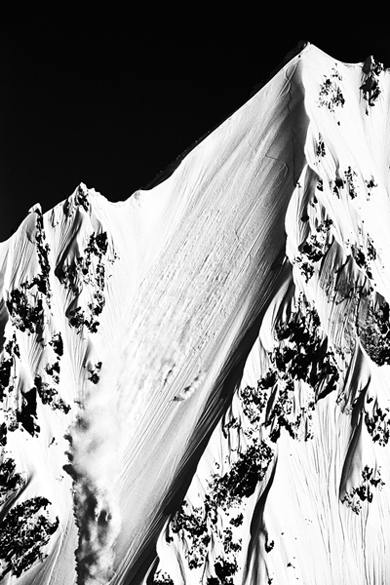
Kitter On The Sphinx
PNH, Chugach Mountains, Cordova, Alaska
Athlete: Jeff McKitterick
Camera: Nikon F5
What makes it special: The monolithic graphic triangular face defines The Sphinx. It is one of the most coveted runs in the Chugach Mountains. For many of the few who have had the chance to ski it, it represents the perfect wave.
The story: "There are very few days when this face is skiable. A stable snowpack, blue skies and zero winds are all critical when even considering taking on this 55-degree, 2000-foot vertical slope. There are many clean, steep, long faces that dot the coastal mountain range, but the Sphinx is slightly canted to insure that all your slough will naturally drift away from you. Practically, this means that as long as you work your way left you never have to worry about being caught in your slough, your wake, your own, self-created avalanche, no matter how fast the snow is moving.
The first time I saw the Sphinx I was standing on top of another mountain a good 20 miles away. Against the background of the horizon, and even behind half a dozen serious peaks, the Sphinx stood out sharply and boldly, calling to me with its angular, fluted, contrasting geometric patterns. We spent the morning working our way towards it, skiing similar aspects on the numerous foreground mountains. By the time we were close, its scale and power had mesmerized us all.
I was on board with a team of guides. PNH owner, Kevin Quinn, threw them all the ultimate bone; today was their day, perfect conditions, foot after foot of fresh stable snow, no wind, no clients, a willing photographer and a hall pass to go out and push hard. We flew over to the peak, peered down at the face and examined the slope of the intensely steep peak...Game on.
To land the chopper on the highly exposed ridge line of the Sphinx, we first had to lighten the load. I got out on the glacier below with all the guides and our gear and watched J Mack flash a smile before buckling back into the copilot seat. We watched them circle back up to the top and then hover. With the nose of the bird carefully balanced on the ridge line, J Mack delicately got out, grabbed his skis and thumbs-upped the pilot. The bird then peeled away, diving back towards us with a white powder trail in its wake. Soon the rest of the boys had loaded back into the bird and flown back up top where J Mack had dug out a 6-by-8 foot platform for the copter to land.
From my camera angle on the opposing glacier I looked through my long lens and watched two small forms shimmy down the ridge to the face. After a few minutes,
J Mack's voice came across the radio, "Kitter's ready."
He dropped in and cut the slope, releasing a massive slab. I fired away as a giant avalanche of snow ripped down the left side of the slope, but Kitter did not hesitate. He committed to his fall line and charged down the slope. He skied the entire 2000 foot- plus face at top speed making no more than 10 turns before shutting it down just above the gaping, berg strum at the bottom. I stood in awe, out of film, inspired by what I had just witnessed but still could not believe.
This mountain had come alive."